

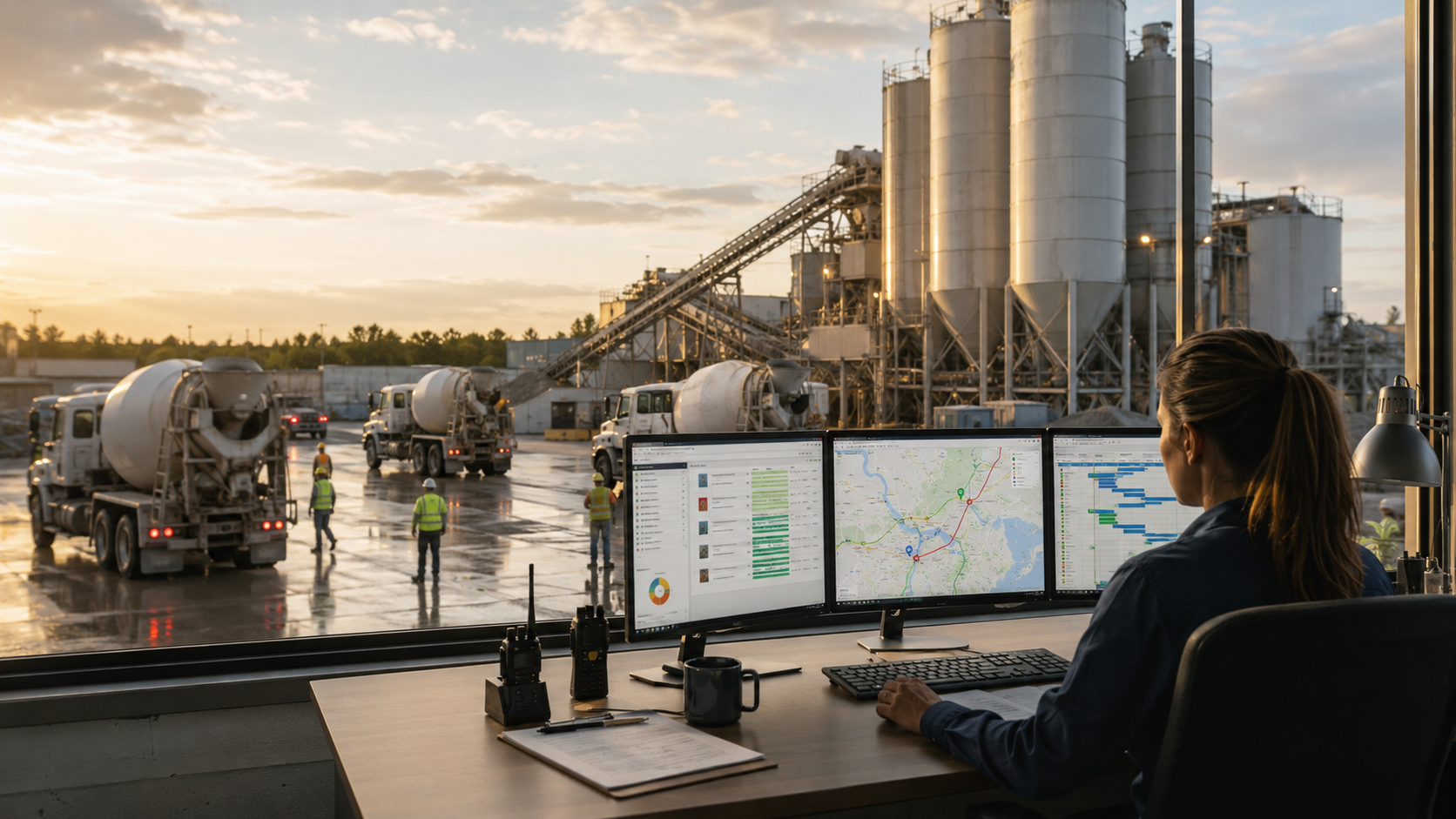
In most industries, dispatch means getting a vehicle from point A to point B at the right time. In ready-mix concrete, that’s only part of the problem. The product itself has a limited shelf life the moment it leaves the plant, which turns every dispatch decision into a race against a clock that’s already running.
Here are 5 realities that set ready-mix dispatch apart from dispatch in most other sectors.
1. The Clock Starts at Batching
Concrete begins setting the moment it’s mixed, giving trucks a limited delivery window, often just a matter of tens of minutes depending on the mix design and weather conditions. A late load isn’t just inconvenient, it can mean a rejected pour on site if the concrete’s consistency is no longer adequate. Unlike other types of freight where a delay simply means a later delivery, here every extra minute eats into the product’s usable window. Heat speeds this process up, which means that same window can shrink further in the middle of summer without anything changing in the mix itself. It’s a constraint few other transport industries have to manage this systematically, load after load.
2. Dispatch Has to Sync With the Plant, Not Just the Road
A truck’s schedule depends on batching capacity as much as traffic on the road. Dispatch has to account for how fast the next truck can load, not only how fast a truck can drive to the site. If the plant can’t keep up with the pace being requested, sending more trucks onto the road doesn’t solve anything, the bottleneck sits somewhere else entirely. That means the right dispatch decision keeps shifting based on what’s happening at the plant, not just what’s happening at the site or in traffic. Dispatch that only watches the road, without accounting for production pace, ends up creating avoidable waiting on both ends of the chain.
3. Idle Trucks Cost More Than Time
When too many trucks queue up at a site, concrete sits in the drum longer than it should while the crew waits instead of pouring. That’s not just lost time for the driver and crew, it’s a direct risk to the quality of the product being delivered, since prolonged agitation can affect the mix’s consistency. A site poorly synced with the plant can turn a queue into a compliance problem, not just a logistics one. And unlike a delay on the road, waiting at the site is often invisible to dispatch until someone actively flags it. Repeating this scenario across multiple sites in the same day can also end up delaying the next deliveries scheduled from that same plant.
4. Delays Change the Math, Not Just the Schedule
A traffic backup doesn’t just push a delivery back, the way it would for most other goods. Depending on how much delay accumulates, it can determine whether that specific load is still usable by the time it arrives, or whether it needs to be rejected and replaced. That reality changes how a delay has to be managed, since it’s no longer just about adjusting an arrival time, it’s about evaluating in real time whether the product in transit is still viable. The same twenty-minute delay can be harmless one day and critical the next, depending on the mix design and the ambient temperature. That’s what makes handling the unexpected in ready-mix concrete trickier than in most transport sectors, where a delay is a delay regardless of the cause.
5. One Plant, Many Competing Orders
Multiple job sites often need trucks around the same time, from the same plant, which creates direct competition for a limited resource. Dispatch has to allocate a limited number of trucks and drivers across all of them, often with priorities shifting throughout the day based on how each pour is actually progressing. A site that falls behind schedule can, as a result, have a cascading effect on the plant’s ability to serve the other sites planned for that same day. That reality means constantly re-evaluating priority order rather than following a fixed schedule set the day before. High-demand days, when several large sites are pouring at once, are usually when this reality is felt the most.
Frequently Asked Questions
Why is ready-mix dispatch different from traditional dispatch?
Because the product being transported has a limited shelf life from the moment it’s batched. Dispatch has to work within a strict time window, on top of the usual routing and traffic considerations.
What happens if a concrete truck is delayed?
Depending on how long the delay lasts, the load may no longer be usable on arrival, which can lead to a rejected pour and the loss of the entire load.
How does a plant manage multiple job sites at once?
By allocating a limited number of trucks and drivers across active orders, often adjusting priorities in real time as each site’s progress changes.
Does ready-mix dispatch account for plant capacity?
Yes. Truck scheduling depends as much on how fast the plant can load the next truck as it does on road and traffic conditions.
More information at cdware.com.